- Go 79.7%
- JavaScript 16.5%
- Rust 2.4%
- Go Template 0.6%
- Makefile 0.3%
- Other 0.4%
 charles
9056501a27 The receiver has to fetch and buffer before it starts, so it can be five or ten seconds behind. The local element does not know that and ran on its own clock, so the progress bar read ahead of the room. Worse, the element reached the end of the track while the device was still playing it, and the player advanced the queue -- cutting the song off on the device partway through. The device's reported position is now authoritative: the player's clock is corrected to it whenever the two diverge. The bar tells the truth, it holds at the start while the device is still buffering, and the element cannot reach the end before the device does, so the queue advances when the song actually finishes rather than when the browser thinks it has. Correcting the element seeks it, which fires the seek callback, so that echo is swallowed rather than relayed -- otherwise every correction would tell the device to jump to where it already is. The tolerance is wide enough to absorb the reporting chain: the server polls the device once a second and the UI polls the server every two. Co-Authored-By: Claude Opus 5 (1M context) <noreply@anthropic.com> |
||
|---|---|---|
| .devcontainer | ||
| .forgejo/workflows | ||
| .github | ||
| adapters | ||
| cmd | ||
| conf | ||
| consts | ||
| contrib | ||
| core | ||
| db | ||
| git | ||
| log | ||
| model | ||
| persistence | ||
| plugins | ||
| release | ||
| resources | ||
| scanner | ||
| scheduler | ||
| scripts | ||
| server | ||
| tests | ||
| ui | ||
| utils | ||
| .dockerignore | ||
| .git-blame-ignore-revs | ||
| .gitignore | ||
| .golangci.yml | ||
| .nvmrc | ||
| CASTING.md | ||
| CODE_OF_CONDUCT.md | ||
| context7.json | ||
| CONTRIBUTING.md | ||
| Dockerfile | ||
| go.mod | ||
| go.sum | ||
| LICENSE | ||
| main.go | ||
| Makefile | ||
| Procfile.dev | ||
| README.md | ||
| reflex.conf | ||

Navidrome Music Server 






Navidrome is an open source web-based music collection server and streamer. It gives you freedom to listen to your music collection from any browser or mobile device. It's like your personal Spotify!
Note: The master branch may be in an unstable or even broken state during development.
Please use releases instead of
the master branch in order to get a stable set of binaries.
Check out our Live Demo!
Any feedback is welcome! If you need/want a new feature, find a bug or think of any way to improve Navidrome, please file a GitHub issue or join the discussion in our Subreddit. If you want to contribute to the project in any other way (ui/backend dev, translations, themes), please join the chat in our Discord server.
Installation
See instructions on the project's website
Cloud Hosting
PikaPods has partnered with us to offer you an officially supported, cloud-hosted solution. A share of the revenue helps fund the development of Navidrome at no additional cost for you.

Features
- Handles very large music collections
- Streams virtually any audio format available
- Reads and uses all your beautifully curated metadata
- Great support for compilations (Various Artists albums) and box sets (multi-disc albums)
- Multi-user, each user has their own play counts, playlists, favourites, etc...
- Very low resource usage
- Multi-platform, runs on macOS, Linux and Windows. Docker images are also provided
- Ready to use binaries for all major platforms, including Raspberry Pi
- Automatically monitors your library for changes, importing new files and reloading new metadata
- Supports lyrics from sidecar .ttml, .yaml/.yml Lyricsfile, .elrc, .lrc, .srt, .txt files and embedded TTML, Enhanced LRC, LRC, SRT, and plain-text tags (via
lyricspriority) - Themeable, modern and responsive Web interface based on Material UI
- Compatible with all Subsonic/Madsonic/Airsonic clients
- Transcoding on the fly. Can be set per user/player. Opus encoding is supported
- Translated to various languages
Translations
Navidrome uses POEditor for translations, and we are always looking for more contributors
Documentation
All documentation can be found in the project's website: https://www.navidrome.org/docs. Here are some useful direct links:
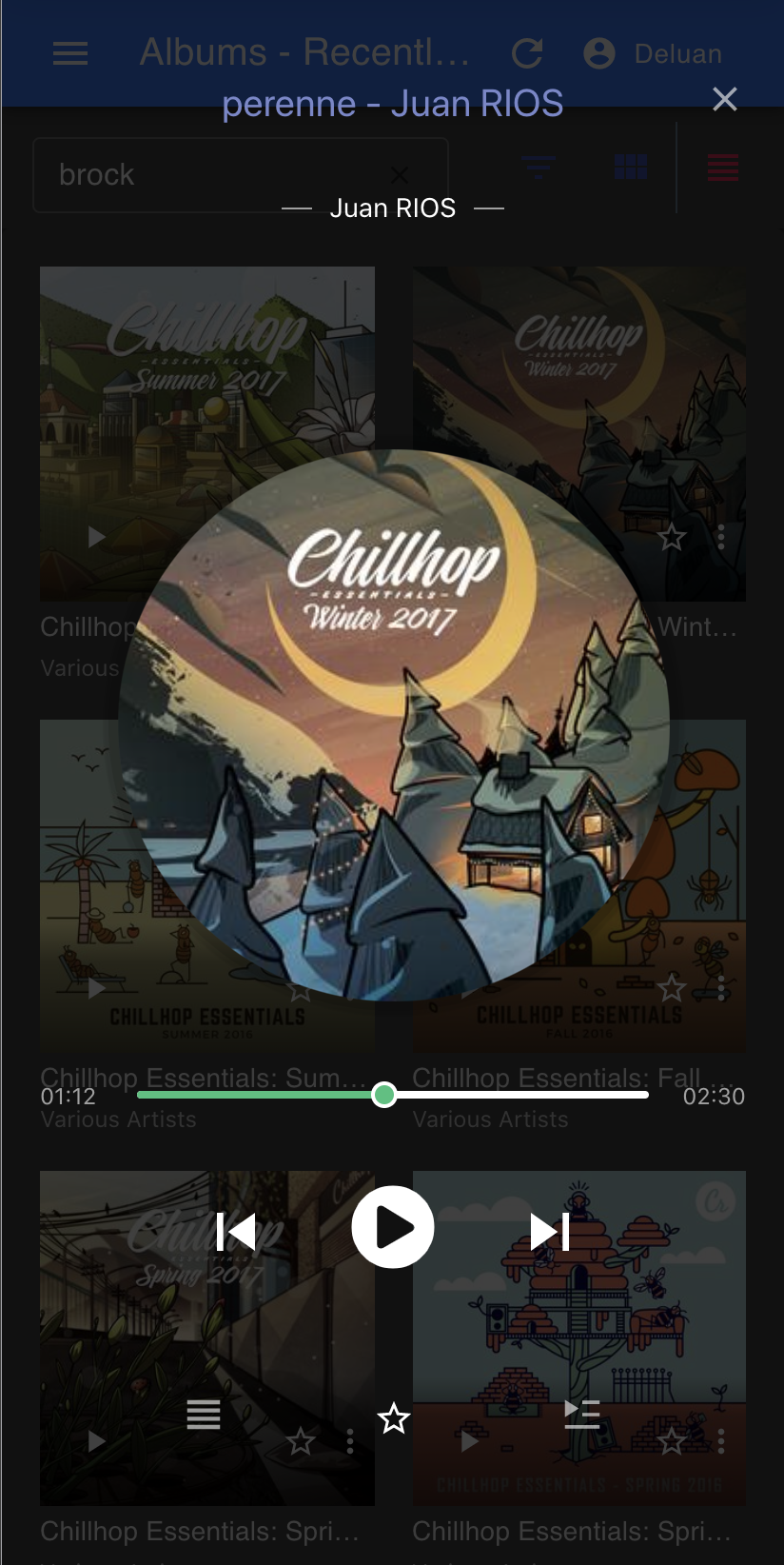
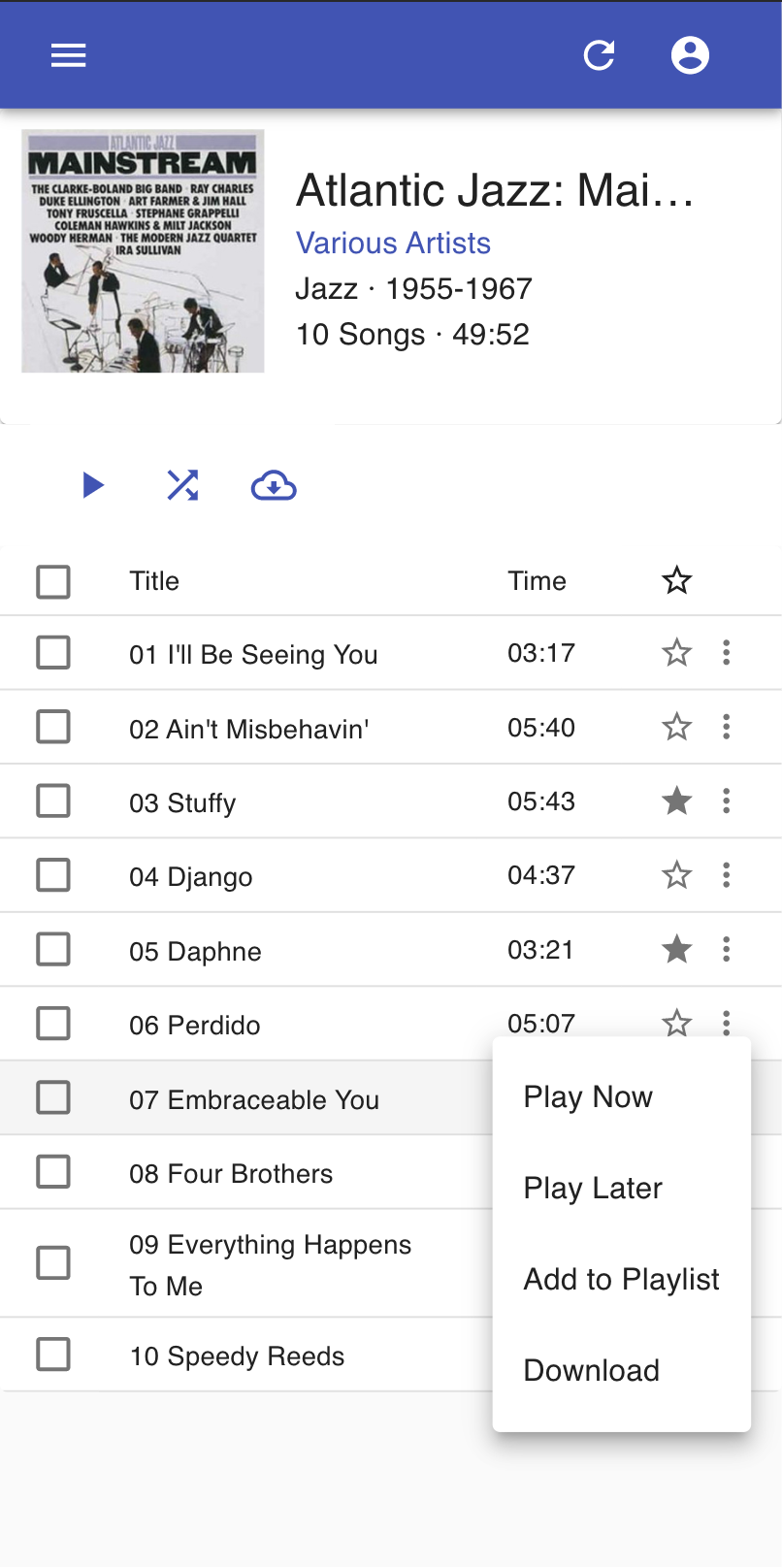
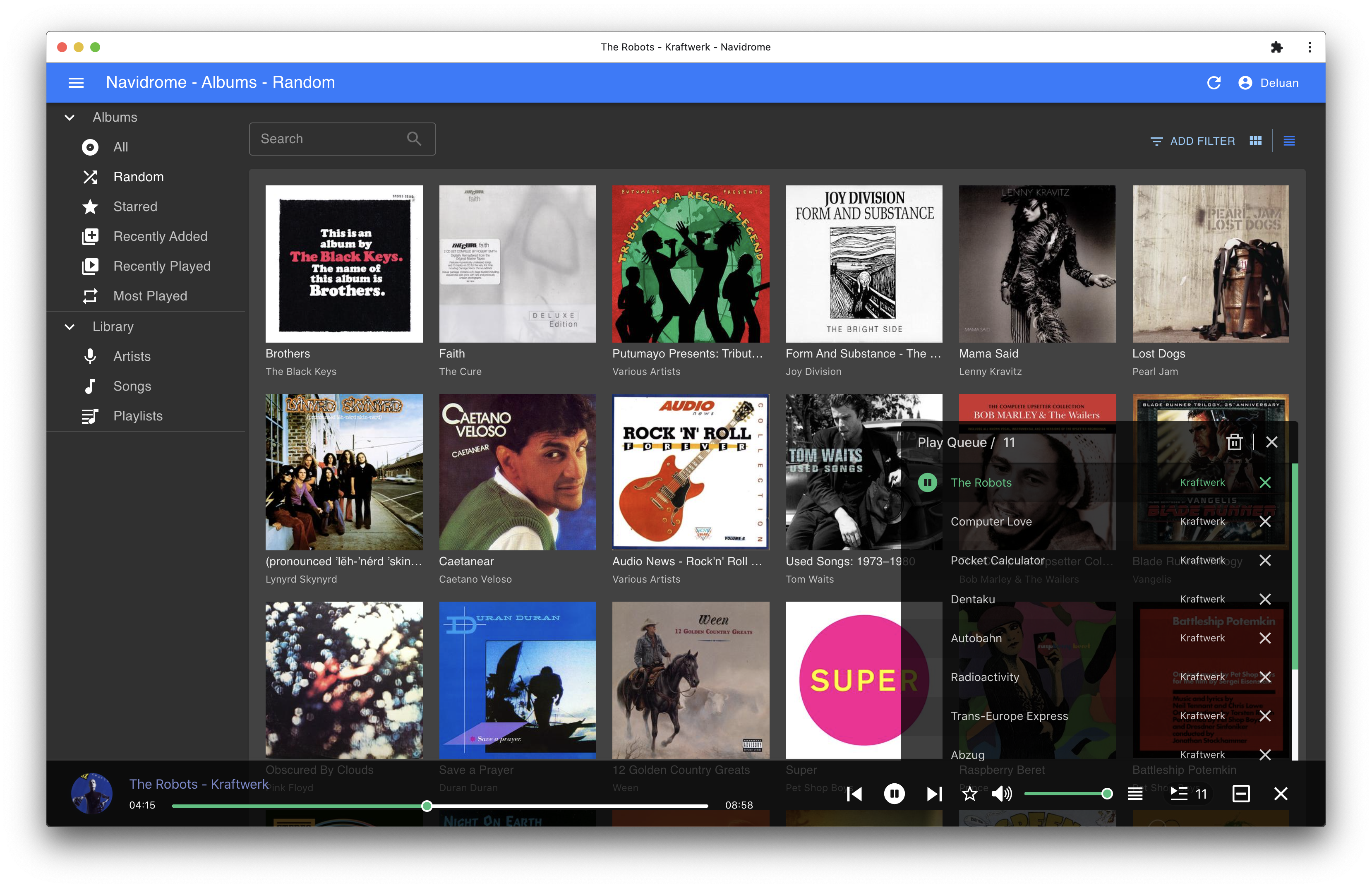
Screenshots